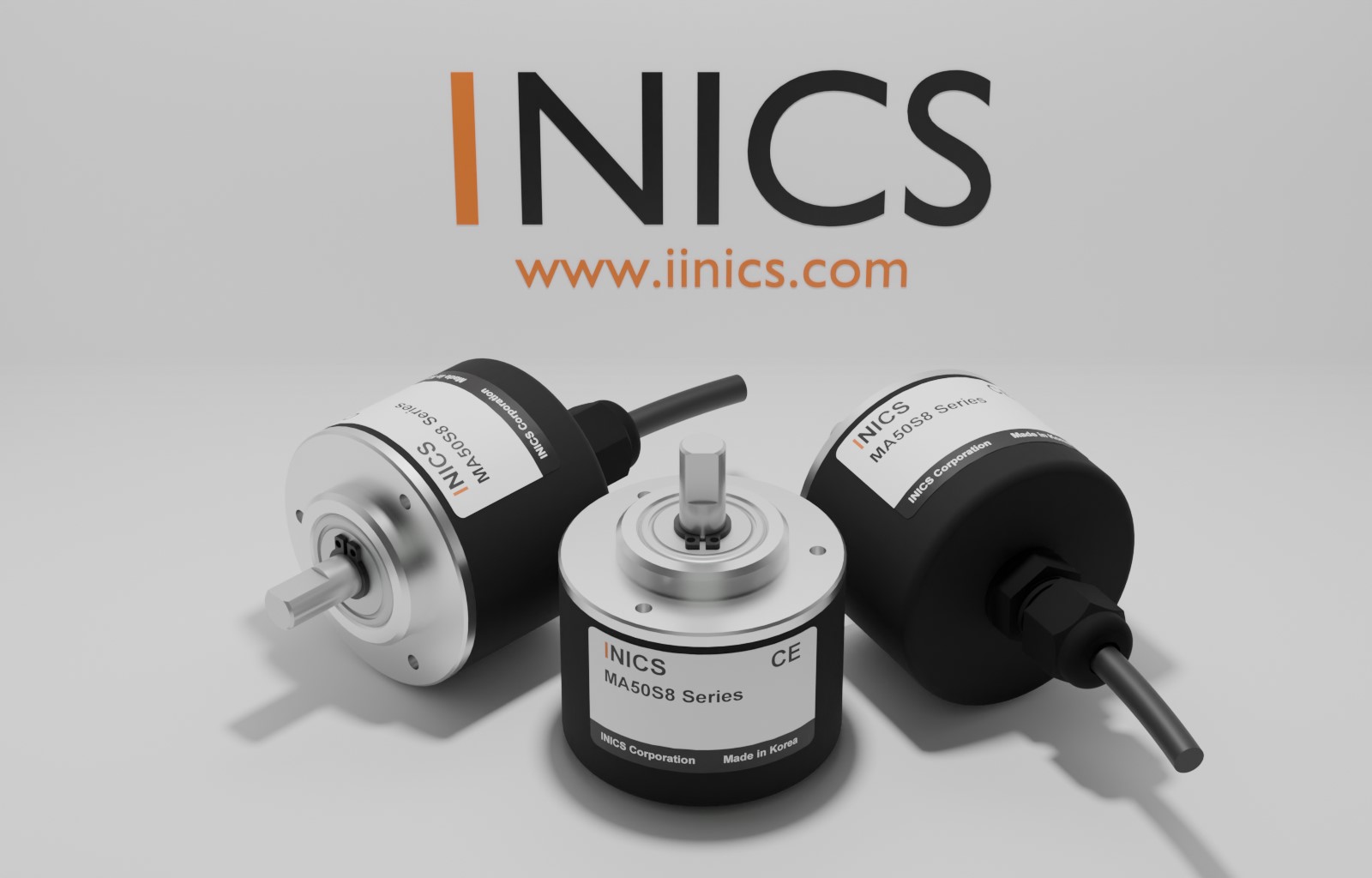
A magnetic absolute encoder reading position from magnetic-field
changes. No optical parts means outstanding durability — highly
reliable even in dust and oil. Shaft type, Ø40/Ø50 mm.
4,096 P/R
Max. Resolution
16,384 REV
Multi-turn
5,000 RPM
Max. Speed
±1 LSB
Hysteresis
Key Features
FEATURE 01
Absolute Position Detection
Every angle outputs a unique code — the position is known the moment
power is applied. No homing sequence, no position loss after
a power interruption.
FEATURE 02
No Optical Parts · High Durability
No optical disk or LED — magnetic sensing only, for outstanding
durability and stable operation in dusty, oily, high-vibration
environments.
FEATURE 03
Binary / Gray Code
Gray code changes only one bit at a time, eliminating misreads
from bit delays. Count direction is selectable (F: CW up / R: CCW up).
BINARYGRAYF / R
FEATURE 04
Parallel NPN / SSI Line Driver
Parallel NPN outputs 10 bit lines (res. 8–1024); SSI streams up to
4096 P/R over a synchronous line-driver interface at 50k–500 kHz.
FEATURE 05
16,384-Rev Multi-turn (SSI)
SSI adds a 14-bit revolution counter (16,384 turns) on top of the
single-turn angle. Note: the multi-turn count resets to 0 at power off.
FEATURE 06
±1 LSB Hysteresis · Rugged · CE
±1 LSB hysteresis suppresses code flicker at boundaries.
50G shock, 5G vibration, IP50, aluminum or PA66-GF30 body,
coupling included. CE certified.
Technology · Sensing Principle
Magnetic Absolute Sensing
Position Known the Moment Power Is On
As the magnet on the shaft rotates, the magnetic sensor reads the field direction and computes the current angle. Every angle maps to a unique digital code, so the absolute position is output instantly — no pulse counting required.
Non-contact magnetic sensing — magnet and sensor never touch, and with no optics it resists contamination.
Angle = unique code — up to 4,096 positions (12 bit), each with its own code.
Gray code option — only one bit changes between adjacent angles, preventing misreads at boundaries.
SSI multi-turn — 14-bit turn count plus single-turn angle in a single serial frame.